Top 10 Tips for Choosing the Right Centrifugal Fan?
Choosing the right centrifugal fan is crucial for optimal performance in various applications. With industries increasingly reliant on efficient airflow, selecting the right equipment is more important than ever. Data from the American Fan Manufacturers Association indicates that improper fan selection can lead to energy losses exceeding 30%. This statistic underlines the necessity of making informed decisions in fan selection.
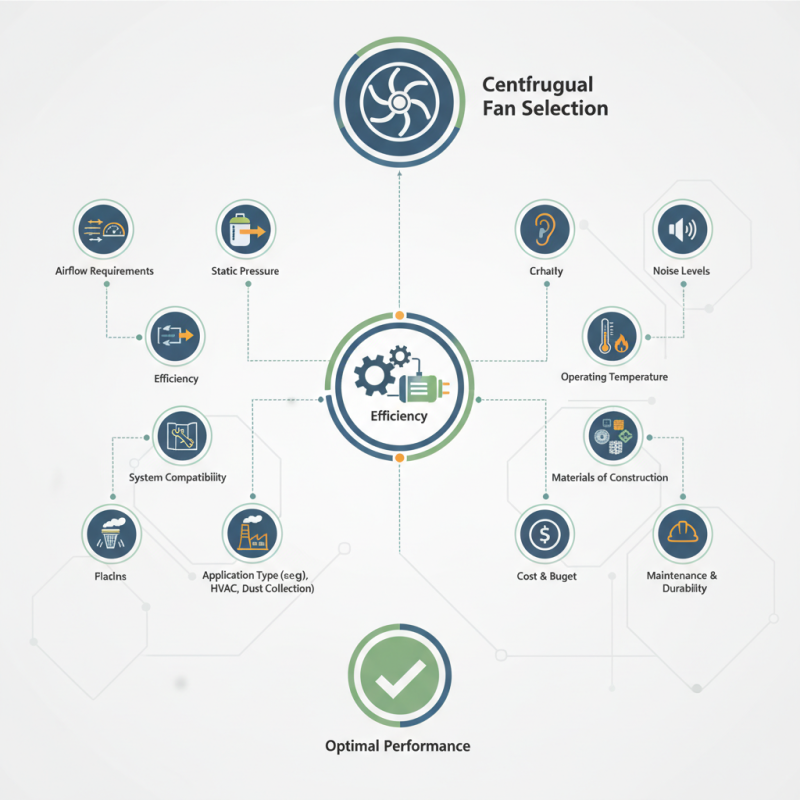
Centrifugal fans are widely used in HVAC systems, dust collection, and industrial applications. According to a report by Market Research Future, the global centrifugal fan market is projected to grow at a CAGR of 3.5% through 2027. As this market expands, buyers face the challenge of navigating numerous options that vary in design and efficiency. Factors like airflow requirements, static pressure, and noise levels need careful consideration.
Many buyers overlook specific details when selecting a centrifugal fan. For instance, the fan’s materials can influence its durability and performance. Ensuring compatibility with existing systems is essential, yet often neglected. This guide aims to illuminate key factors in fan selection, helping you avoid common pitfalls.
Understanding the Basics of Centrifugal Fans and Their Applications
Centrifugal fans play a crucial role in various applications. They are widely used in HVAC systems, material handling, and dust control. Understanding their basic operational principles can help in making informed choices. According to industry reports, about 30% of industrial energy consumption is attributed to fans. Thus, an efficient fan can lead to significant energy savings.
These fans operate by converting rotational energy to airflow. The key components include an impeller, housing, and a motor. Impeller design affects performance and efficiency directly. A well-designed impeller can improve flow rates by over 20%. Applications vary widely, from cooling electronic devices to ventilating mines. Yet, many users overlook specific needs, leading to poor performance.
Noise levels also matter. Research indicates that improper sizing can increase noise by up to 50%. Ideally, a fan should be matched carefully to its application. This requires careful consideration of airflow requirements and pressure levels. Regular maintenance is another critical factor. Neglect can lead to reduced efficiency and a shorter lifespan. Understanding these aspects can lead to better choices in selecting the right centrifugal fan for your needs.
Key Factors to Consider When Selecting a Centrifugal Fan
When selecting a centrifugal fan, several key factors should guide your choice. Airflow requirements are crucial. The fan's capacity must match the system's needs for efficiency. According to industry reports, improper airflow can reduce efficiency by up to 30%. This inefficiency creates unnecessary energy costs and can lead to overheating.
Another important aspect is pressure rating. Each fan has a specific operating range that defines its ability to overcome resistance in the system. Choosing a fan with an insufficient pressure rating may result in performance issues. For optimal operation, ensure the fan's pressure capabilities align with your system's requirements.
Tip: Always consider the fan's noise level. A quieter fan improves working conditions. Some fans operate at noise levels as low as 50 dB while others can exceed 85 dB. Retraining may be required if noise impacts productivity.
It's vital to analyze the motor type as well. AC and DC motors present different benefits and drawbacks. AC motors are generally more durable, while DC motors offer variable speed control. Balancing these factors can lead to better performance but requires thoughtful analysis.
Rethink your choices. A thorough evaluation will ensure you select the right fan for your needs. Don’t overlook details. They can often make or break efficiency and performance in the long run.
Top 10 Tips for Choosing the Right Centrifugal Fan
| Key Factor |
Description |
Importance |
Example Values |
| Airflow Capacity |
The volume of air that the fan can move. |
Critical for ensuring adequate ventilation. |
1000 - 20000 CFM |
| Static Pressure |
The resistance the fan must overcome to move air. |
Essential for performance in ducted systems. |
0.5 - 10 inches WG |
| Noise Level |
The sound produced by the fan during operation. |
Important for comfort and regulatory compliance. |
Below 70 dB |
| Efficiency |
How well the fan transforms energy into airflow. |
Directly affects operational costs. |
60% - 90% |
| Fan Size |
Physical dimensions of the fan unit. |
Must fit in the designated space. |
12" - 60" Diameter |
| Blade Design |
Shape and angle of fan blades that influence airflow. |
Affects performance in different applications. |
Forward-curved, backward-curved, axial |
| Material |
Construction material of the fan. |
Affects durability and resistance to corrosion. |
Aluminum, Steel, Plastic |
| Mounting Type |
Way the fan is installed in the system. |
Influences installation complexity and costs. |
Base-mounted, Inline |
| Cost |
Total investment required for the fan. |
Must align with budget and ROI expectations. |
$200 - $5000 |
Importance of Airflow and Pressure Requirements in Fan Selection
When selecting a centrifugal fan, understanding airflow and pressure requirements is crucial. The right fan can significantly impact performance. Airflow is measured in cubic feet per minute (CFM). Knowing the required CFM helps maintain efficiency in the system. Insufficient airflow can lead to overheating or inadequate ventilation.
Pressure requirements also play a vital role. Static pressure affects fan performance. Too much resistance can limit airflow, reducing efficiency. It’s essential to calculate the total static pressure in your system. Failing to do so might result in insufficient fan capacity. This can lead to poor performance and increased energy consumption.
Not all fans are created equal. Some may meet airflow needs but fail in pressure requirements. It’s important to review specifications carefully. Often, there are trade-offs. A fan designed for high airflow may struggle with static pressure. Realizing these nuances requires thoughtful consideration. Look at your specific application. It may need adjustments based on real-world performance. Testing can reveal gaps in initial assumptions.
Evaluating Fan Efficiency: Why It Matters for Your Project
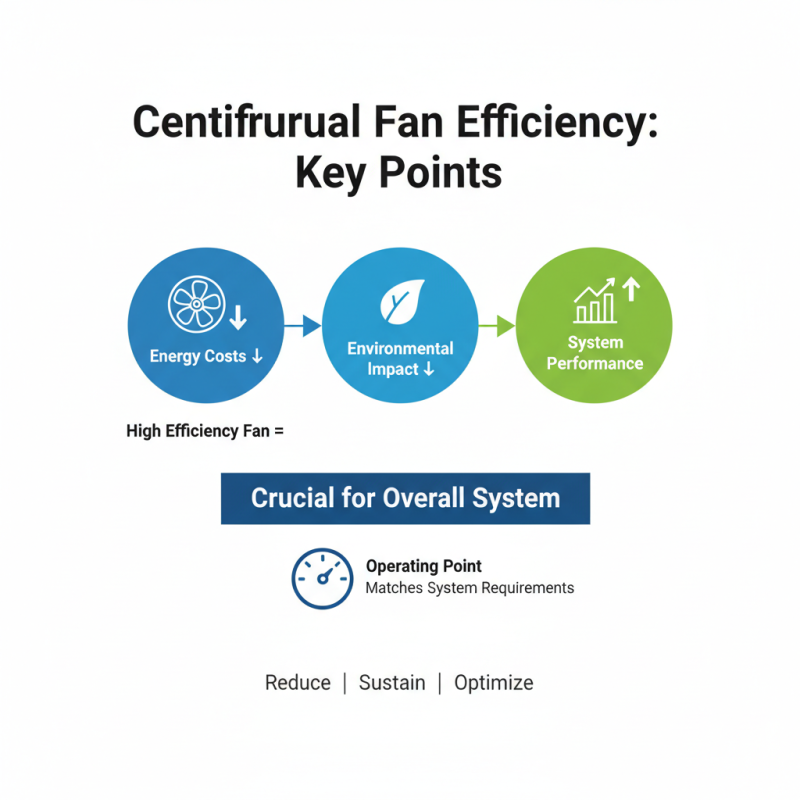
When choosing a centrifugal fan, evaluating its efficiency is crucial. Fan efficiency affects overall system performance. A high-efficiency fan can significantly reduce energy costs. It also minimizes environmental impact, which is increasingly important in many projects. Pay attention to the fan's operating point to ensure it matches your system's requirements.
Consider the fan's design and materials. These factors influence both durability and efficiency. For instance, a fan with optimized blade geometry will perform better than a basic model. However, sometimes the more complex designs can lead to maintenance issues. Reflecting on this, simplicity may sometimes be the best approach.
Noise levels are another aspect to think about. An efficient fan should operate quietly. High noise can disrupt work environments and affect productivity. But, achieving low noise levels might require trade-offs. It's important to strike a balance between efficiency and sound levels, ensuring all project needs are met.
Assessing Noise Levels and Acoustic Performance in Centrifugal Fans
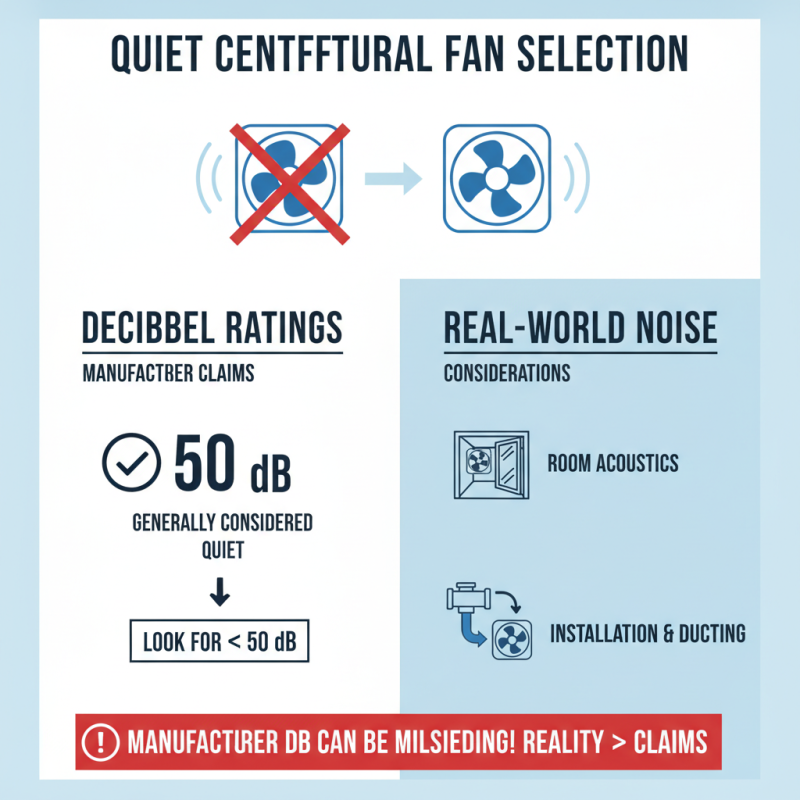
When selecting a centrifugal fan, noise levels play a crucial role. A quiet fan can significantly improve comfort in residential or commercial spaces. Evaluate the decibel ratings provided by manufacturers. A fan that operates below 50 dB is generally considered quiet. However, these figures can sometimes be misleading. Real-world conditions often amplify sound levels.
Acoustic performance is not just about numbers. It’s essential to understand how the fan’s design affects noise. Factors like blade shape, motor type, and housing can enhance or reduce sound output. Observing the fan in operation is advisable. Listen for vibrations and tonal variations. These subtle cues indicate how noise might affect your environment over time.
Testing in a controlled setting can reveal issues that specs won't show. Consider the type of installation as well. A poorly mounted fan may vibrate, producing excessive noise. Look for features like sound insulation or mounting options that minimize disturbance. These choices impact acoustic performance significantly. Sometimes a fan that seems ideal on paper can be a source of annoyance in practice.